This guide gives you the 9-point checklist Jiasheng Plastics uses with food-industry buyers in the US, EU, and Latin America. By the end you'll know exactly what to demand from your UHMWPE supplier — and what red flags should make you walk away.
1. The two regulations every food-line buyer must know
Food-contact UHMWPE in 2026 falls under two main regulatory frameworks. Most global food plants demand both:
- FDA 21 CFR 177.1520 — US food contact regulation for olefin polymers. UHMWPE qualifies under subsection (c) item 3.1 if produced from approved resins. The supplier must hold a written FDA letter from the resin manufacturer (Celanese, Mitsui, or LyondellBasell) — not a self-issued declaration.
- EU 10/2011 — European plastics-in-food-contact regulation. Requires a Declaration of Conformity (DoC) listing every additive, migration test results, and manufacturer site address. JSPolymers issues a DoC for every food-grade order.
NSF/ANSI 51 (food equipment materials) and 3-A Sanitary Standards (dairy) are additional voluntary marks but increasingly demanded by Tier-1 food brands.
2. Blue, white, or natural? Color choice has compliance implications
The classic factory-floor question. Each color carries a different regulatory burden:
| Color | Pigment used | Food contact OK? | Visual benefit |
|---|---|---|---|
| Natural (translucent) | None | Yes — easiest compliance | Minimal, but stains show fast |
| White | TiO₂ (food grade) | Yes if TiO₂ is FDA-listed | Clean look, low contrast vs food |
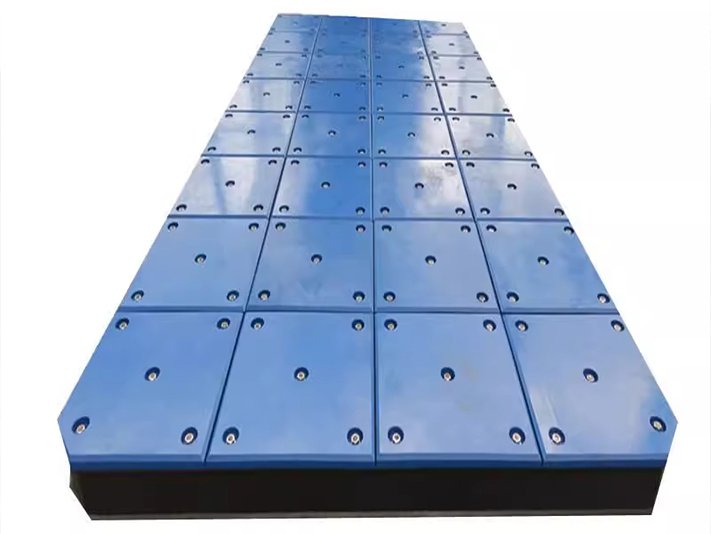
| FDA blue | PB29 ultramarine | Yes — most common in food machinery | Foreign-body detection — fragments are highly visible vs most food |
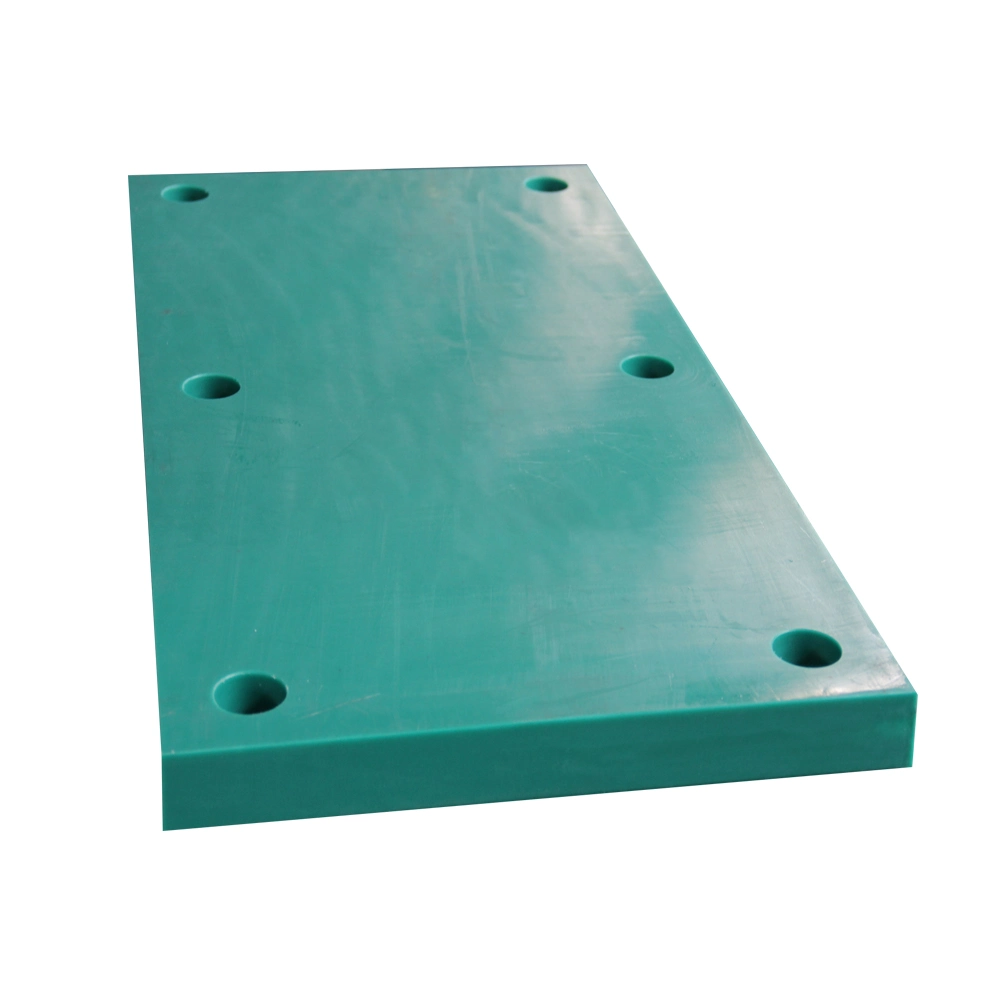
| Green | Phthalo green | Some grades only — verify migration test | Niche use, e.g. produce packing lines |
| Carbon black | Carbon black | Generally NOT food-safe | Outdoor / non-food use only |
3. The 9-point buyer's checklist
Print this list, attach to every food-grade RFQ. Suppliers who tick all 9 are real factories with active food customers:
- ✅ FDA letter from resin manufacturer (PDF, current within 24 months)
- ✅ EU 10/2011 Declaration of Conformity for the specific batch
- ✅ Migration test report (overall + specific migration, e.g. for 10% ethanol simulant)
- ✅ NSF/ANSI 51 listing if you supply Tier-1 brands like Nestlé, Tyson, JBS
- ✅ 3-A Sanitary Standard if dairy contact
- ✅ Supplier ISO 22000 or FSSC 22000 food-safety management system
- ✅ Allergen-free declaration — UHMWPE itself is allergen-free, but additives or shared production lines may not be
- ✅ Heavy metals certificate (lead, cadmium, mercury, arsenic) per Prop 65 if shipping to California
- ✅ Batch traceability — every sheet must carry a batch number traceable to resin lot, production date, and QC report
4. Top 6 food-industry applications for UHMWPE
Where UHMWPE actually earns its premium price in food plants:
- Cutting boards — High-density, knife-friendly, dishwasher-safe. JSPolymers offers FDA-blue for foreign-body detection.
- Conveyor wear strips — Replace stainless rails on bottle/can lines for quieter, lower-friction operation.
- Scraper blades — Tank scrapers, freezer-conveyor scrapers, dough-trough scrapers. Self-lubricating, no metal-on-metal wear.
- Chute liners — Cereal grain, sugar, frozen-veg chutes. Anti-stick prevents bridging.
- Filler-machine guides — Bottle fillers, pouch fillers, capper guides. UHMWPE's low friction reduces line jams.
- Cold-room fittings — UHMWPE works down to –200 °C without embrittling, ideal for IQF freezer tunnels.
5. Three audit-day red flags
If your QA auditor finds any of these, the food line is at risk of a major non-conformance:
- FDA letter older than 36 months — Resin manufacturers update letters periodically. An expired letter = no compliance.
- Self-issued FDA declaration only — A supplier saying "we are FDA compliant" without the underlying resin-manufacturer letter has nothing.
- No batch number on the sheet edge — If you can't trace a contamination event back to a production batch, you can't isolate the problem and you've lost the audit.
6. Pricing — what to expect for food-grade UHMWPE in 2026
FOB Qingdao, JSPolymers indicative pricing for FDA-compliant UHMWPE sheet:
| Thickness × Width × Length | Color | Price (USD/kg) | MOQ |
|---|---|---|---|
| 10 × 1000 × 2000 mm | Natural / White | Quote on request | 500 kg |
| 10 × 1000 × 2000 mm | FDA blue | Quote on request | 500 kg |
| 20 × 1500 × 3000 mm | Natural | Quote on request | 1 ton |
| 30 × 2000 × 4000 mm (custom) | FDA blue | Quote on request | 2 tons |
| Cutting board kit, 18 × 24 × 0.75 in | FDA blue | Quote on request | 100 pieces |
❓ Frequently Asked Questions
❓ Is UHMWPE BPA-free?
Yes. UHMWPE contains no bisphenol-A, bisphenol-S, or phthalates. It's a pure polyethylene homopolymer.
❓ Can UHMWPE go in commercial dishwashers?
Yes, up to about 80 °C continuously. Above 90 °C, UHMWPE softens and may warp. Use lower-temp wash cycles for sheet products to maintain dimensional stability.
❓ Does FDA blue color leach into food?
No. PB29 (ultramarine) is FDA-listed and tightly bound in the polymer matrix. Migration tests consistently show < 0.01 mg/dm² — well below the 60 mg/kg overall migration limit.
❓ How does UHMWPE compare to HDPE for cutting boards?
HDPE is the industry standard for cutting boards because it's cheaper, easier to resurface, and meets food contact. UHMWPE is overspec for typical kitchen use but excels in food-machinery wear parts where service life matters.
❓ Can I get a sample before placing a full order?
Yes. JSPolymers ships A4-sized food-grade samples free worldwide. Lead time 5-7 days. Email [email protected] with your application details and our engineering team will recommend the best grade.
❓ Do you supply NSF/ANSI 51 listed UHMWPE?
Yes — for Tier-1 food customers we source resin from NSF-listed manufacturers and provide the certification chain. Add 5-10% to standard pricing.