Table of Contents
If you're specifying fender pads for a new berth — or replacing worn-out facings on an existing one — the material question shows up early. Rubber? Steel? UHMWPE? Each has loyalists, each has horror stories. This 2026 comparison is built from 15+ years of supplying UHMWPE facings into 80+ ports across 4 continents, and from the post-mortem reports we've seen on what fails first.
The short version: rubber is the energy-absorbing structural unit, steel is sometimes the cheap fallback, and UHMWPE is what sits between the rubber and the hull. But the reasons UHMWPE has steadily replaced steel and bare-rubber facings in modern terminals are worth understanding before your next PO goes out.
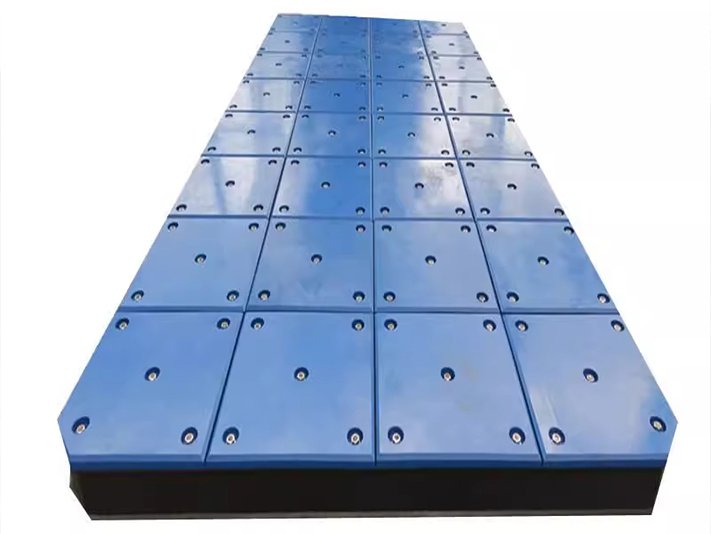
UHMWPE cell-fender face panels in our production line — black & blue UV-stabilized PE1000.
1. Why Fender Material Matters
A marine fender system has two jobs:
- Absorb berthing energy — convert the kinetic energy of a vessel into deformation work, then return to shape. This is the rubber unit's job.
- Protect the hull during contact — distribute the contact pressure, allow the hull to slide rather than shear, and survive thousands of berthing cycles. This is the facing pad's job.
Most damage claims and replacement costs trace back to the second job, not the first. A rubber cone or cell can last 25–30 years; the facing in front of it is what gets gouged, cracked, and replaced every 3–10 years depending on traffic and material choice.
2. The Three Realistic Options
| Material | Typical Use | Why People Pick It |
|---|---|---|
| UHMWPE (PE1000) | Tanker terminals, container quays, ferry berths, naval bases | Lowest hull friction, longest service life, reparable |
| Bare rubber face | Light-duty marinas, RoRo ramps, low-tide protection | Cheapest unit cost, no facing fasteners |
| Steel plate facing | Legacy berths, heavy industrial cargo with sharp edges | Cheap upfront, easy local fabrication |
HDPE pads also exist as a budget alternative to UHMWPE — but they wear ~5× faster and crack at low temperatures, so we won't include them in the head-to-head.
3. Friction & Hull Damage
This is where UHMWPE wins decisively. Friction coefficient against a wet steel hull:
| Facing Material | Coefficient of Friction (wet, steel hull) | Effect on Hull Paint |
|---|---|---|
| UHMWPE PE1000 | 0.10 – 0.15 | Hull slides; minimal paint scuff |
| Bare SBR rubber | 0.50 – 0.80 | High shear; paint stripped, gel-coat cracked |
| Mild steel plate | 0.25 – 0.45 | Paint scuff plus rust transfer to hull |
For VLCC tankers and LNG carriers — where a single coating repair can cost six figures — the hull-friendly behavior of UHMWPE is the single biggest argument for paying the material premium. Container terminals report 60–70% reduction in paint-touch-up scope after switching from steel-faced fenders to UHMWPE-faced units.
4. Abrasion & Lifecycle
Sand, salt, and barnacle grit accelerate wear on every facing material. Comparative abrasion (Sand-Slurry test, ASTM G75 reference, ranked):
- UHMWPE — relative wear index 1.0 (baseline)
- HDPE — 4 – 6×
- Mild steel — 8 – 12× (also corrodes)
- Bare rubber — variable, but typically 15 – 25× as a sliding face (rubber excels in compression, not in shear)
Translated to service life on a busy container berth (12 berthings per day, mixed vessel sizes):
| Facing | Typical Replacement Interval | Reparable On-Site? |
|---|---|---|
| UHMWPE 50 mm | 10 – 15 years | Yes — bolt-on swap |
| UHMWPE 30 mm | 6 – 10 years | Yes |
| Steel 12 mm | 5 – 8 years (corrosion-driven) | Hot-work repair, requires permits |
| Bare rubber facing | 3 – 6 years (shear failure) | Replace whole unit |
5. Energy Absorption Behavior
An important misconception: UHMWPE pads do not absorb energy — they distribute it. Energy absorption is the rubber unit's job (cone, cell, arch, or pneumatic). The pad's role is contact-pressure distribution and hull protection.
This is also why "thicker UHMWPE = more energy absorbed" is wrong. Going from 30 mm to 100 mm UHMWPE doesn't absorb more berthing energy — it just adds local cushioning under sharp hull features (anchor pockets, frame seams, belt-frame ribs) and extends service life as a wear consumable.
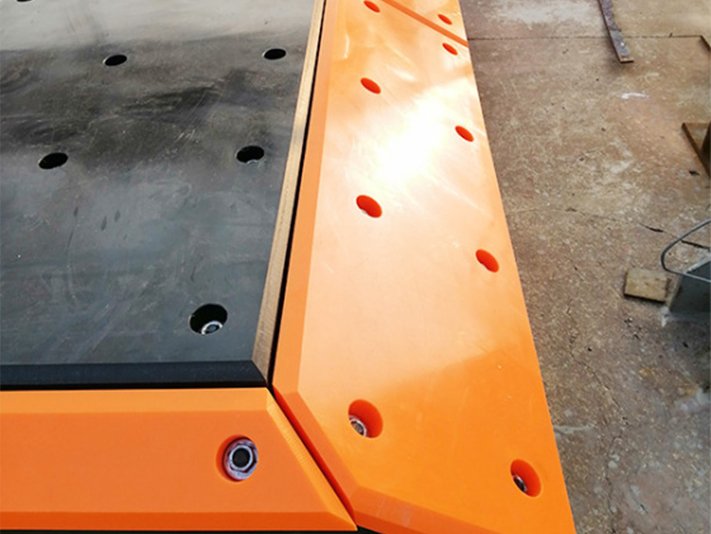
Orange high-visibility UHMWPE corner-panel kit for tug-boat & work-boat contact zones.
6. Chemistry & Environment
| Property | UHMWPE | Rubber (SBR/NR) | Steel |
|---|---|---|---|
| UV resistance | Excellent (carbon-black or stabilizer) | Cracks 5–10 yrs without recoat | Requires zinc + paint system |
| Saltwater corrosion | None — inert | None | Pit corrosion, sacrificial anodes needed |
| Hydrocarbon resistance | Excellent (tankers, refineries OK) | Swells in oils; needs nitrile blend | Excellent |
| Service temperature | -200°C to +80°C | -30°C to +80°C | Wide, but brittle below -40°C |
| Recyclable | Yes (re-extrudable) | Difficult (rubber crumb only) | Yes |
The temperature window matters more than people expect. Arctic terminals (Murmansk, Sabetta) and tropical ports (Singapore, Jebel Ali) both fall comfortably inside UHMWPE's range. Steel becomes brittle below -40°C; standard rubber stiffens and loses energy-absorption efficiency.
7. 5-Year Cost Analysis (per linear metre of berth)
Purchase price tells you almost nothing — total cost of ownership tells you everything. Indicative figures for a medium-traffic container berth, 50 m of fender frontage, 5 cell-fender units:
| Cost Item (per m of berth, 5-yr horizon) | UHMWPE-faced | Steel-faced | Bare rubber |
|---|---|---|---|
| Initial facing material + install | ★★★ Higher | ★★ Mid | ★ Lowest |
| Hull paint touch-up reimbursement | ★ Lowest | ★★★ High | ★★★ Highest |
| Facing replacement cycles in 5 yr | 0 – 1 | 1 – 2 | 2 – 4 |
| Berth downtime for repairs | ★ Lowest | ★★ Medium | ★★★ Highest |
| 5-yr total cost | ★★ Lower | ★★★ Higher | ★★★ Higher |
UHMWPE is rarely the cheapest line item on day 1. It is consistently the cheapest line item by month 24.
8. Decision Matrix by Berth Type
| Berth Type | Recommended Facing | Typical Spec |
|---|---|---|
| VLCC / LNG tanker terminal | UHMWPE 50 – 100 mm | Black UV-stabilized, A4 stainless studs |
| Container quay (Panamax+) | UHMWPE 30 – 50 mm | Black or blue, drilled per cell-fender pattern |
| RoRo ramp & ferry berth | UHMWPE 30 mm + rubber W-fender | High abrasion, chamfered edges |
| Tug-boat / work-boat berth | Orange UHMWPE corner panel | High-vis, low-friction sliding face |
| Light-duty marina (yachts) | Bare rubber D-fender or vinyl | Low cost; UHMWPE overkill here |
| Mooring dolphin (occasional contact) | UHMWPE 30 mm or steel + paint | Cost-driven; either works |
9. Procurement Spec Checklist
When sending an RFQ for UHMWPE marine fender facings, include:
- Resin grade — PE1000 (≥ 4 million g/mol) or PE500 if non-sliding cushion only
- Color & UV package — black (carbon-black, best UV); blue or orange (UV stabilizer added); high-vis orange specifically for corner panels and small-craft contact
- Thickness — 30 / 50 / 75 / 100 mm typical; specify hull pressure if known
- Sheet size — 1000 × 2000 mm or 1220 × 2440 mm standard; cut-to-size on request
- Bolt pattern — DXF / PDF with stud locations, hole diameter, countersink depth, edge chamfer
- Fastener spec — A4 / 316 stainless; counter-bored holes for studs to sit below contact face
- Edge treatment — radius all exposed edges (R6 minimum) to prevent hull catch and pad chip-out
- Markings — batch number, resin grade, production date stamped on non-contact face
- QA documents — material mill cert, SGS / FDA / RoHS verified cert, density / molecular weight test report
- Packaging — palletized with corrugated PE corner protection, plywood crate for ocean freight
10. FAQ
How are large fender pads assembled — single sheet or multiple panels?
Large fender faces are bolted up from multiple CNC-cut panels with a 3 – 5 mm gap between panels for thermal expansion. We supply each panel as a separate machined piece sized to your bolt pattern, drilled and counter-bored ready for installation. No on-site fabrication, no specialty tooling required at the dock.
Why specify A4 (316) stainless studs instead of A2 (304)?
A4 / 316 stainless contains molybdenum, which dramatically improves chloride pitting resistance in saltwater. A2 / 304 will start to pit within 12 – 24 months of seawater exposure. The cost difference is small; the consequence of stud failure is total pad detachment.
How do I know if my existing fender pads are UHMWPE or HDPE?
UHMWPE has a slightly waxier feel and is harder to scratch with a fingernail. The most reliable test is density (UHMWPE 0.93 – 0.95 g/cm³, HDPE 0.94 – 0.97) combined with a melt-flow test — but practically, HDPE pads will show visible wear grooves within 2 – 3 years on a busy berth, while UHMWPE remains visually intact for 8+ years.
Can I retrofit UHMWPE pads onto rubber fenders that originally had steel facing?
Yes — and this is one of the most common upgrades we ship. Most cell, cone, and arch fenders use a standard frontal bolt pattern that accepts UHMWPE in place of steel. Send us the existing fender model number and bolt pattern and we'll quote the matching UHMWPE pad set.
Does the orange / blue color affect performance?
No. Color is purely a visibility / branding choice. All UV-stabilized colors (orange, blue, green, yellow) deliver equivalent mechanical performance to black PE1000. Black uses carbon-black for UV protection (slightly cheaper); colored grades use a UV stabilizer additive.
Specifying a Fender Project?
Send your drawing — we quote in 24 hours. MOQ from 1 piece. Production photos available on request.
View UHMWPE Marine Fender Specs »« Related: How to Size UHMW-PE Marine Dock Fenders | All Blog Posts | Product Specs