Table of Contents
- 1. Why UHMW-PE Faces Are Industry Standard
- 2. The PIANC Berthing-Energy Formula
- 3. Vessel-to-Fender Quick Sizing Table
- 4. Choosing Pad Thickness
- 5. Geometry: Square, Rectangular, Arc
- 6. Mounting Methods & Hardware
- 7. UHMW-PE vs Rubber vs HDPE Fenders
- 8. Marine Corrosion & UV Resistance
- 9. Installation & Replacement Best Practices
- 10. 8-Point Specification Checklist
- 11. FAQ
Specifying a marine dock fender system is one of the highest-stakes decisions a port engineer makes. Under-size and you risk hull damage, dock structure damage, vessel-down days and insurance claims. Over-size and you waste capital on absorption capacity that will never be called upon. This guide walks you through the engineering math, the geometry decisions and the material selection — focused specifically on UHMW-PE facing pads, the wear-and-impact layer that sits on the front of every modern rubber fender system.
1. Why UHMW-PE Faces Are Industry Standard
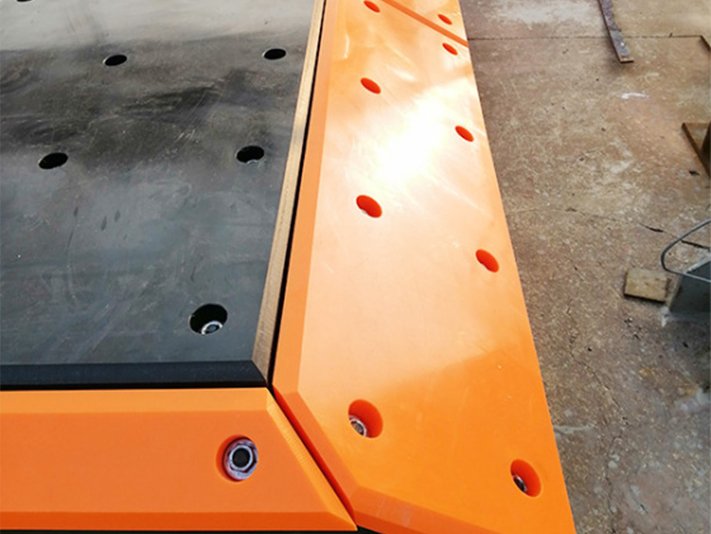
Modern marine fender systems are composite: a rubber energy-absorbing element (cone, cell, arch or pneumatic) mounted to the dock structure, with a face plate bolted to the rubber to spread vessel hull pressure. UHMW-PE has displaced steel, HDPE and rubber-only facings in port specifications globally because of five engineering advantages:
- Coefficient of friction 0.10–0.15 — about 1/3 of HDPE and 1/8 of rubber. The vessel slides along the face during berthing instead of sticking and ripping the fender free.
- Abrasion resistance 6–10× better than steel. Sand-laden hulls and barnacle scour do not erode UHMW-PE.
- No corrosion. Saltwater immersion and tidal cycling — irrelevant.
- Self-lubricating — even when icy or fouled.
- Low temperature impact — Charpy notched impact >100 kJ/m² down to −60 °C, so Arctic ports stay protected.
2. The PIANC Berthing-Energy Formula
The international standard is PIANC WG33 (2002) "Guidelines for the Design of Fender Systems". Berthing energy E (in kNm) is computed as:
Where:
- M = vessel mass at berthing (tonnes), typically 0.5 × DWT for ballast or 1.0 × DWT for laden
- V = berthing velocity perpendicular to dock (m/s); 0.10–0.30 m/s for tugged vessels, up to 0.50 m/s for ferries
- Cm = added hydrodynamic mass coefficient (1.4–2.0)
- Ce = eccentricity coefficient (0.4–0.7 depending on point of impact)
- Cs = softness coefficient (1.0 if rigid hull)
- Cc = berth-configuration coefficient (1.0 open berth, 0.8 closed)
E = 0.5 × 50,000 × 0.15² × 1.5 × 0.55 × 1.0 × 1.0 = 464 kNm.
You then specify a rubber fender unit rated ≥ 510 kNm (10% safety margin) and dimension the UHMW-PE face to cover its full impact area + 25% overlap.
3. Vessel-to-Fender Quick Sizing Table
For preliminary specification (before hiring a full marine engineer), use this lookup table covering 95% of commercial berth scenarios:
| Vessel Class | DWT | Energy (kNm) | Recommended Rubber Fender | UHMW-PE Face (mm) |
|---|---|---|---|---|
| Yacht / pilot boat | <200 | 5–15 | Arch 200H | 500×500×30 |
| Tug / fishing vessel | 200–800 | 20–50 | Arch 400H | 800×800×40 |
| Coastal cargo | 1,000–5,000 | 50–150 | Cone 800H | 1200×1200×40 |
| Container feeder | 5,000–20,000 | 150–300 | Cone 1000H | 1500×1500×50 |
| Bulker / Panamax | 20,000–80,000 | 300–600 | Cone 1300H or Cell 1000H | 2000×2000×50 |
| Capesize / VLCC | 80,000–300,000+ | 600–2,000 | Cone 1600H + dual | 2500×2500×60 |
| RoRo / Cruise | 10,000–60,000 | 200–500 | Pneumatic Yokohama | Wrapped chain net |
4. Choosing Pad Thickness
Thicker is not always better. UHMW-PE pad thickness is governed by three factors:
- Hull pressure transmitted (MPa). Higher pressure = thicker pad to spread the load.
- Expected wear life. Each cm of UHMW-PE delivers approximately 8–12 years of service in saltwater under typical commercial berth use.
- Bolt-shear strength. The pad must be thick enough that the M16/M20 stainless mounting studs do not pull through.
| Hull Pressure | Recommended Thickness | Service Life (yrs) |
|---|---|---|
| <0.20 MPa (yachts) | 20–30 mm | 10–15 |
| 0.20–0.40 MPa (cargo) | 30–50 mm | 12–20 |
| 0.40–0.70 MPa (bulkers) | 50–80 mm | 15–25 |
| >0.70 MPa (VLCC, ice ops) | 80–120 mm | 20–30 |
5. Geometry: Square, Rectangular, Arc
Three pad geometries are stocked by major OEMs:
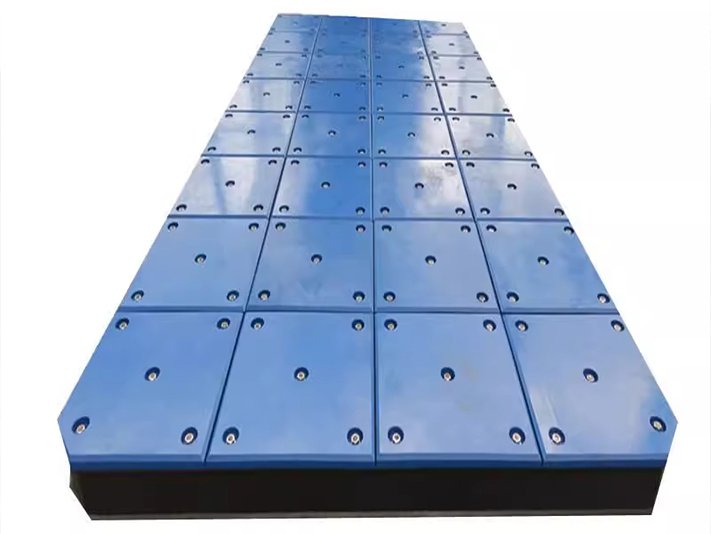
- Square (most common). 1–2.5 m sides. Easiest to manufacture and replace.
- Rectangular tall (3:1 ratio). For high-tide-range ports — covers vessel hull at multiple tide states without re-positioning.
- Arc / curved. CNC-machined from thick UHMW-PE block to match a contoured rubber fender (typical on cone fenders).
All three are produced in solid color (black is default; bright yellow available with HALS UV stabilizer for pilot vessels and ferries that want high-visibility berths).
6. Mounting Methods & Hardware
| Method | Hardware | Best For |
|---|---|---|
| Through-Bolted | A4-316 stainless studs, washers, lock nuts | Standard cone & cell fenders |
| Woint-Stud | Studs fastened to rubber backing plate, pad slips on, captured by nut | Repeat replacement under tight schedule |
| Recessed Counterbore | Bolt heads sit below pad surface — protects from hull contact | Pads expecting heavy abrasion |
7. UHMW-PE vs Rubber vs HDPE Fenders
| Property | UHMW-PE Face | Rubber Face | HDPE Face |
|---|---|---|---|
| Coefficient of friction | 0.10–0.15 ✓ | 0.5–0.8 | 0.25–0.30 |
| Abrasion (Sand Slurry test) | ~80 mg loss ✓ | ~250 mg | ~180 mg |
| Hull paint damage | Minimal ✓ | Black smear common | Light scuffing |
| Cold weather impact (−40°C) | No degradation ✓ | Stiffens, can crack | Brittle below −20°C |
| Replacement intervals | 15–25 yrs ✓ | 5–10 yrs | 8–12 yrs |
| Per-pad cost | 2–3× HDPE | Often integrated | Baseline |
UHMW-PE wins on every performance metric except upfront cost — and the lower replacement frequency typically pays back the price premium within 5–7 years.
8. Marine Corrosion & UV Resistance
UHMW-PE itself is fully resistant to saltwater, gasoline, diesel, hydraulic oil and most cargo-spill chemicals. It does not absorb water (<0.01% by weight after 24 h immersion). It does need 2–3% carbon-black UV stabilizer for outdoor use; without it, the upper surface chalks and embrittles after 3–5 years of equator-latitude sun.
For marine specifications we recommend UV-grade UHMW-PE PE1000 with carbon-black master batch as the default. For high-visibility yellow pads (pilot stations, harbor patrol), use HALS-stabilized colored compound — service life will be 7–10 years rather than 20+ but visibility benefits often justify the trade-off.
9. Installation & Replacement Best Practices
- Pre-drill stud holes oversized by 2–3 mm to allow thermal expansion (UHMW-PE has 4× the thermal expansion of steel).
- Torque stainless bolts to ~70% of yield (typically 90–120 Nm for M20) — do not over-torque, which can crack the pad.
- Use a stainless or composite backer washer, never a galvanized one (galvanic corrosion).
- For tidal ports, schedule replacement during slack tide — never during ebb when current can swing a 200 kg pad.
- Stamp each pad with installation date using a heated branding iron — the trace mark survives 20 years of service and supports warranty claims.
10. 8-Point Specification Checklist
- Material: PE-UHMW per DIN EN ISO 11542, virgin grade, molecular weight ≥ 5 million g/mol.
- Color & UV: Black with 2.5% ± 0.5% carbon black, OR colored with HALS additive.
- Density: 0.93–0.94 g/cm³.
- Charpy notched impact (ISO 11542): > 100 kJ/m² at −30 °C.
- Abrasion (sand slurry, ISO 15527): ≤ 100 mg loss per cycle.
- Surface finish: Smooth molded skin, max Ra 3.2 μm.
- Mounting hole tolerance: ± 1 mm; counterbore depth tolerance: ± 0.5 mm.
- Hardware: A4-316 stainless studs M16 or M20, with Belleville washers under nuts.
11. FAQ
How long do UHMW-PE marine fender pads typically last?
15–25 years in commercial port service, depending on traffic frequency, cargo type and pad thickness. Yacht-marina pads can exceed 30 years.
Can UHMW-PE fenders replace rubber fenders entirely?
No — they work as a system. The rubber unit absorbs energy; the UHMW-PE face spreads load and provides low friction. Removing the rubber would transfer the full impact directly to the dock structure.
What's the difference between UHMW-PE and HDPE fender pads?
UHMW-PE has 5× longer molecular chain, giving 6–10× better abrasion resistance and 1/2 the friction coefficient. HDPE is acceptable for low-traffic marinas; UHMW-PE is the commercial-port standard.
What's the typical lead time?
Stock pads (square, standard sizes 800×800 to 2000×2000): 7–10 days. Custom CNC-machined arc and tall rectangular pads: 25–35 days. Containerized sea freight Asia → Europe: 30–35 days.