Table of Contents
- 1. What Are HDPE Ground Protection Mats?
- 2. Load Ratings & PSI Decoded
- 3. Standard Sizes & Thicknesses
- 4. Surface Textures: Diamond, Cleat, Smooth
- 5. Connection Systems & Locking
- 6. HDPE vs Plywood vs Composite Mats
- 7. Top 8 Applications by Industry
- 8. Rent vs Buy — Break-Even Math
- 9. Container Loading & Shipping
- 10. 12-Point Vendor Checklist
- 11. 2026 Wholesale Pricing Reference
- 12. Frequently Asked Questions
If you operate a rental fleet, manage utility access, plan turnkey events, or run a heavy civil project, you have probably watched plywood ground covers fail under a 30-tonne crane outrigger after one rainy week. HDPE ground protection mats exist precisely because plywood was never engineered for that load profile.
This guide is written by an engineering plastics OEM (Dezhou Jiasheng — exporting HDPE mats to North America, EU, Australia and the Middle East since 2013). It distills 13 years of production data, customer field feedback and ASTM testing into one practical specification document. By the end you will know exactly which load class, thickness, surface texture and connection system to specify for your jobsite — and which 12 questions to ask any vendor before placing a PO.
1. What Are HDPE Ground Protection Mats?
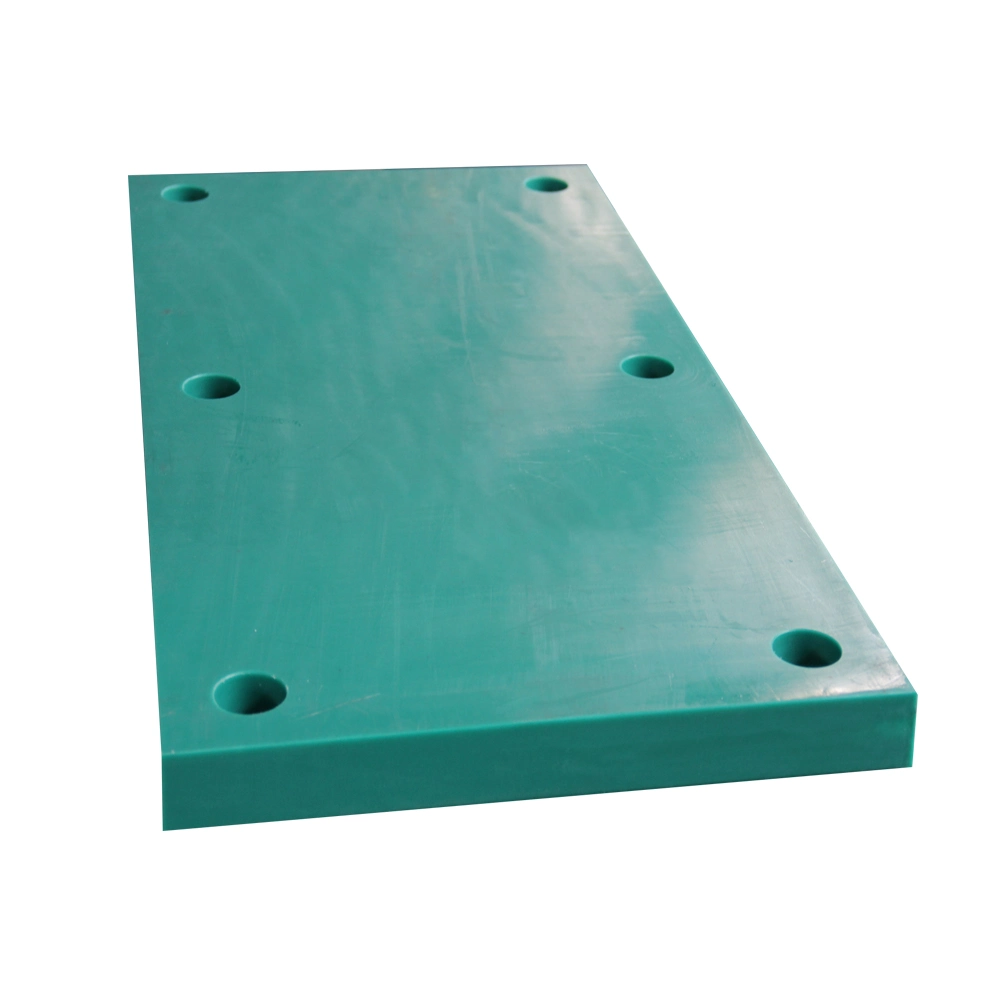
HDPE ground protection mats — sometimes called access mats, bog mats, rig mats, composite mats or track mats — are rigid sheet products molded from recycled or virgin high-density polyethylene (HDPE) that distribute concentrated point loads (a crane outrigger, a tracked excavator, a 53-foot semi-trailer wheel) across a much larger area, protecting the underlying turf, asphalt, sand or concrete from rutting, cracking and compaction damage.
The standard product is a 4'×8' (1219×2438 mm) panel, 1/2" (12.7 mm) to 2" (50.8 mm) thick, weighing 35–95 kg per panel depending on grade. Both faces are typically textured (diamond pattern, cleat pattern or ribbed) to provide grip for tracked equipment and pedestrian safety in wet conditions.
2. Load Ratings & PSI Decoded
Vendor data sheets quote loads in three different units. Knowing the difference is the single most important decision in this guide:
| Metric | What it Measures | Typical Value | When You Need It |
|---|---|---|---|
| Point Load (PSI) | Pressure under a single concentrated contact (an outrigger pad, a track lug) | 120–600 PSI | Cranes, drill rigs, tracked excavators |
| Distributed Load (PSF) | Total weight per square foot of mat area | 5,000–20,000 PSF | Static loads, lay-down yards, equipment storage |
| Axle Load (tonne) | Marketing-friendly number based on a typical 4-wheel axle distribution | 40 t / 80 t / 120 t | Quick comparison only — always verify PSI |
For a typical 80-tonne crawler crane with a 24" × 24" outrigger pad, the actual point load on the mat is about 340 PSI. A 1/2" diamond-pattern HDPE mat handles ~250 PSI; a 1" mat handles ~600 PSI; a 2" composite (HDPE-bonded laminated) mat handles ~1,200 PSI. Always size up by 30% as a safety margin.
3. Standard Sizes & Thicknesses
| Size (ft) | Metric | Thickness | Weight (kg) | Best For |
|---|---|---|---|---|
| 4×8 | 1219×2438 mm | 1/2" (12.7 mm) | 35–40 | Light vehicles, events, turf protection |
| 4×8 | 1219×2438 mm | 3/4" (19 mm) | 50–55 | Cranes ≤40 t, utility trucks |
| 4×8 | 1219×2438 mm | 1" (25.4 mm) | 65–75 | Cranes 40–80 t, drill rigs |
| 4×8 | 1219×2438 mm | 2" (50.8 mm) | 90–95 | Cranes >100 t, oil & gas pads |
| 2×8 | 610×2438 mm | 1/2" | 17–20 | Pedestrian walkways, narrow access |
| 3×8 | 914×2438 mm | 3/4" | 40–45 | Single-vehicle access roads |
| 4×6 | 1219×1828 mm | 1/2" | 27–30 | Tight-radius event flooring |
4. Surface Textures: Diamond, Cleat, Smooth
Surface texture is molded directly into the HDPE sheet during the press cycle. The three industry-standard patterns:
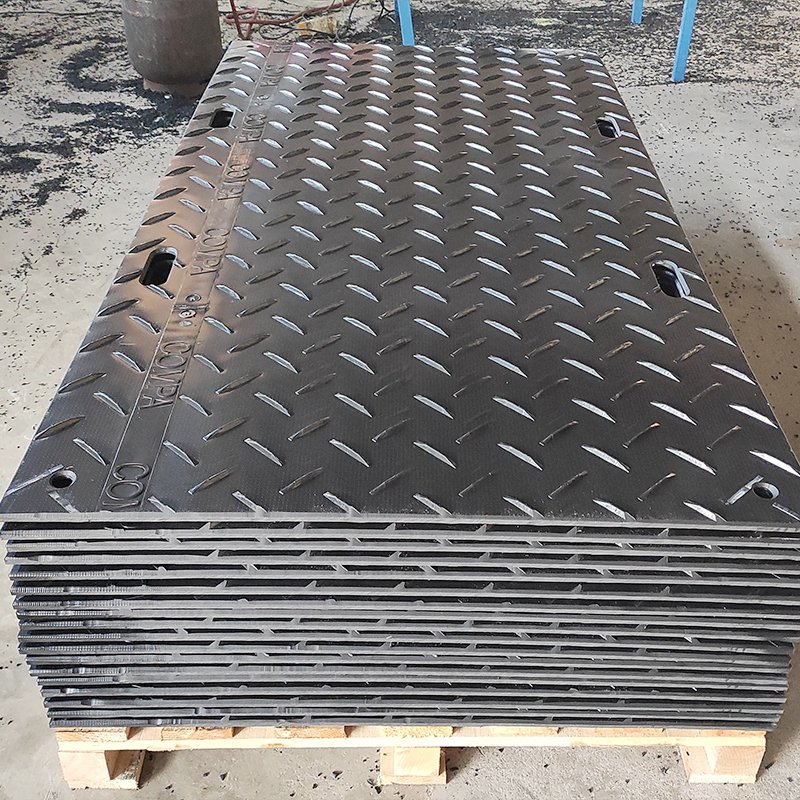
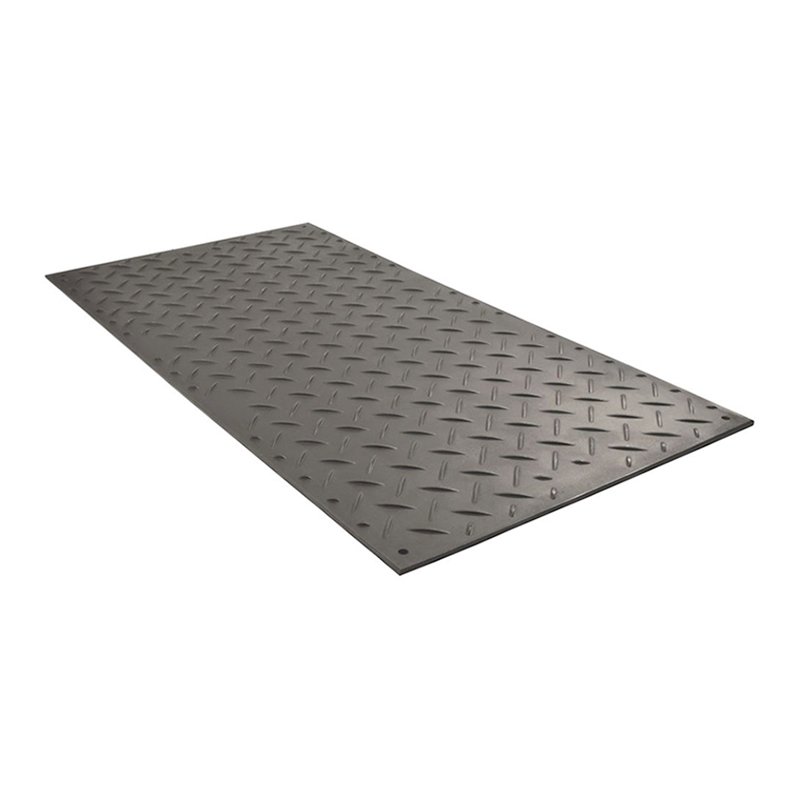
Diamond Pattern (D2 / D3)
Embossed 4–6 mm diamond knurls. The default choice — provides grip for both tracked and wheeled equipment, sheds mud and water, and is low enough profile to be safe for pedestrians. Used in 70% of all rental yard fleets.
Cleat / Lug Pattern (C4)
Aggressive 8–12 mm raised lugs in herringbone or chevron arrangement. Reserved for muddy access roads and slopes >5°. Provides 40% more pull-out resistance for tracked equipment but is uncomfortable to walk on and harder to clean.
Smooth or Fine-Ribbed (S1 / R1)
For indoor event flooring, exhibition halls, semi-permanent walkways. Easy to clean and to apply graphics on. Not recommended outdoors in rain.
5. Connection Systems & Locking
For roadways, pads or platforms, individual mats must lock together so that an axle crossing the joint does not lift one mat and dive into the next. Three connection systems are standard:
| System | How It Works | Pros | Cons |
|---|---|---|---|
| Cam-Lock (rotating disc) | Plastic cam molded into the mat edge rotates 90° to engage adjacent mat | Tool-free, fast, no loose parts | Cams can wear after 200+ cycles |
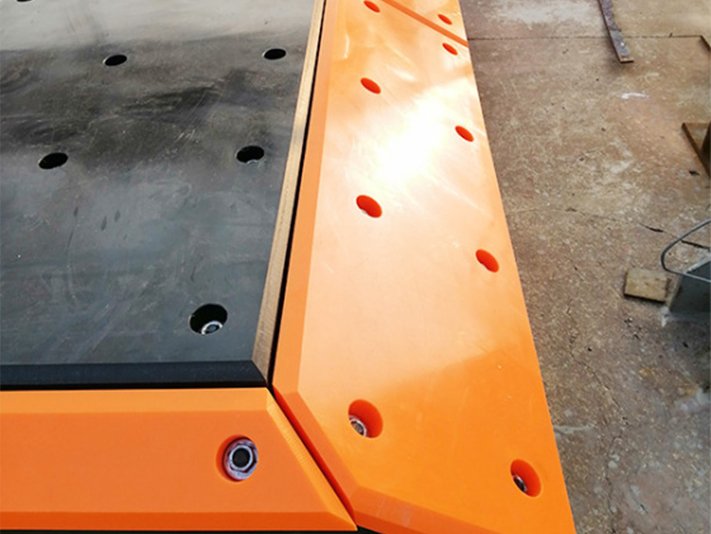
| Bolt-Through | M16 galvanized bolt through factory-drilled holes | Strongest connection (15 t shear) | Requires wrench, slower install |
| Hand-Hole + D-Ring | Recessed handles double as anchor points for chains/straps | Quickest to deploy/recover | Less rigid joint, allows micro-movement |
6. HDPE vs Plywood vs Composite Mats
| Metric | 3/4" Plywood | 1/2" HDPE | 4" Hardwood Composite |
|---|---|---|---|
| Upfront cost (per panel) | Quote on request | Quote on request | Quote on request |
| Weight (kg) | 22 | 38 | 140 |
| Service life | 2–4 weeks | 10+ years | 5–8 years |
| Reusability | 0–2 cycles | 500+ cycles | 30–50 cycles |
| Water absorption | 40–80% gain | <0.1% | 5–10% |
| Recyclable | Burn / landfill | 100% melt-down | Limited |
| 5-year TCO (per panel) | Quote on request+ | Quote on request | Quote on request |
The 5-year TCO row is the punchline. HDPE is ~7× cheaper than plywood over a five-year repeat-use horizon, despite the 5× higher purchase price.
7. Top 8 Applications by Industry
- Crane & rigging. Outrigger pads under 40–600 t cranes on lawns, asphalt parking lots, brick pavers.
- Utility / power line access. Temporary roads for pole-set trucks across farmland and wetlands.
- Oil & gas drilling. Permanent rig pads for drilling fluid containment and equipment lay-down.
- Event production. Concert stages, festival walkways, marquee floors over grass.
- Wind turbine installation. Crawler crane access through forestry tracks and erosion-sensitive soils.
- Pipeline construction. Sidebooms and pipe-laying tractor pads in marshland.
- Disaster relief / military. Helicopter landing pads and forward operating base flooring.
- Sports / equestrian. Temporary dressage arenas and horse-trailer parking.
Want a deep dive on each application? See our companion guide 10 Industrial Applications of UHMW-PE in 2026 — the same engineering principles apply to UHMW-PE, just with even higher abrasion resistance.
8. Rent vs Buy — Break-Even Math
Most rental yards quote HDPE mats at Quote on requestper panel per week. Purchase price is Quote on requestper panel. The simple break-even is:
Quote on request ÷ Quote on request = 10.3 weeks of cumulative use.
If your project schedule shows the mats deployed for >10 weeks total (across multiple sites or one long site), buying makes financial sense even before counting freight, insurance and damage waivers (typically 20–30% on top of the rental rate).
Three buyer profiles where purchase always wins:
- Equipment rental yards. Mats become a high-margin add-on rental SKU. Payback in 4–6 months.
- Pipeline / utility prime contractors. Multi-year project portfolios with 30+ active sites.
- Event production companies. Recurring venues every weekend during peak season.
9. Container Loading & Shipping
HDPE mats ship economically by sea container thanks to their flat-pack form factor. Loading capacity by container:
| Container | Mats Loaded (1/2", palletized) | Mats Loaded (1/2", floor-loaded) | Total Weight (t) |
|---|---|---|---|
| 20 GP | 40–48 | 56–64 | 2.0–2.5 |
| 40 GP | 85–95 | 110–125 | 4.5–5.5 |
| 40 HQ | 90–110 | 120–140 | 4.8–6.0 |
Standard sea freight (Qingdao → Long Beach, 30 days) for a 40 HQ runs Quote on requestin 2026 — about Quote on requestper mat in landed freight cost. We palletize on heat-treated wood pallets stamped IPPC ISPM-15 (compliant with US, EU, AU phytosanitary rules).
10. 12-Point Vendor Checklist
Use this checklist on every quote you receive — any vendor that cannot answer 10/12 in writing should be avoided.
- Is the HDPE virgin material, regrind, or post-consumer recycled? (Virgin = predictable performance, regrind = 20–30% cheaper but variable)
- What is the carbon-black UV stabilizer percentage? (Target: 2–3%)
- Tested point load PSI per ASTM D6109 — share certificate.
- Tested distributed load PSF per ASTM D6109.
- What is the published service life under repeat outrigger use? (10 years is standard claim)
- Connection system options offered (cam-lock, bolt-through, hand-hole)?
- Surface texture options offered (D2 / D3 / C4 / S1 / R1)?
- Color options and corresponding UV stability? (Black = 10 yr; colored = 5–7 yr)
- Production lead time at MOQ 50 mats vs MOQ 500 mats?
- Container loading capacity and packing method (palletized vs bulk)?
- Phytosanitary certification on pallets (ISPM-15)?
- Warranty terms — do they cover delamination, cracking, UV chalking?
11. 2026 Wholesale Pricing Reference
| Product | FOB China (USD/panel) | FOB China at MOQ 500 (USD/panel) |
|---|---|---|
| 4×8 × 1/2" Standard Diamond Black | Quote on request | Quote on request |
| 4×8 × 3/4" Heavy Duty Diamond Black | Quote on request | Quote on request |
| 4×8 × 1" Premium Cleat Black | Quote on request | Quote on request |
| 4×8 × 2" Composite Bog Mat | Quote on request | Quote on request |
| 2×8 × 1/2" Walkway Mat | Quote on request | Quote on request |
12. Frequently Asked Questions
What is the typical load rating of an HDPE ground protection mat?
Standard 4'×8' HDPE mats (1/2" thick) carry 40 tons per axle; heavy-duty composite mats (1"+) carry 80–120 tons. Always confirm the manufacturer's published Point Load (PSI) and Distributed Load (PSF) ratings, ideally tested per ASTM D6109.
HDPE mats vs plywood — which is more cost-effective?
Per deployment, HDPE costs 4–6× more upfront, but lasts 10+ years vs 2–4 weeks for 3/4" plywood. Total cost of ownership over 5 years is 70–85% lower for HDPE in repeat use cases.
What surface texture should I order — diamond, cleated, or ribbed?
Diamond pattern (D2) for general crane outrigger use; deep cleat (C4) for muddy access roads and slopes >5°; smooth or fine-ribbed for indoor event flooring.
How many HDPE mats fit in a 40HQ container?
A 40HQ container holds 90–110 mats (4'×8' × 1/2" thick) when palletized, or up to 130–140 mats when bulk-loaded. Total weight is approximately 4.8–6 tonnes.
Are HDPE ground mats UV stable?
Yes, when manufactured with 2–3% carbon-black UV stabilizer. Carbon-black grades reach 10+ year outdoor life. Colored mats (yellow, blue, green) require HALS UV additives and have shorter 5–7 year outdoor life.