If you have ever specified plastic for a heavy-wear conveyor liner, a marine fender, or a chemical-handling tank, you have almost certainly come across UHMW-PE. But what exactly is it, why does it cost 3–5× more than ordinary HDPE, and when should you actually use it? This guide answers every question we get from our customers — engineers, OEMs, and maintenance managers — in one place.
Table of Contents
1. What Is UHMW-PE?
UHMW-PE stands for Ultra-High Molecular Weight Polyethylene. It is a subset of the polyethylene family with an average molecular weight typically between 3,000,000 and 10,000,000 g/mol — roughly 30 to 100 times longer than the polymer chains found in standard HDPE (around 200,000 g/mol).
This extreme chain length is the source of every special property the material is famous for. Long chains entangle so tightly that the resulting plastic behaves almost like a self-lubricating, rubberised metal — resisting impact, abrasion, and chemicals far better than any other commodity polymer.
You may also encounter the trade name PE1000 (common in Europe) or simply UHMWPE (without the hyphen). All refer to the same base material. ASTM D4020 is the international standard that defines and classifies UHMW-PE grades by molecular weight.
2. Key Physical & Mechanical Properties
Below is the typical property profile of virgin UHMW-PE (PE1000) at room temperature, based on ISO and ASTM test methods. Values represent direct-extruded sheet stock; compression-moulded sheet may differ slightly.
| Property | Typical Value | Test Standard |
|---|---|---|
| Molecular weight | 3 – 10 million g/mol | ASTM D4020 |
| Density | 0.93 – 0.94 g/cm³ | ISO 1183 |
| Tensile strength at yield | 17 – 25 MPa | ISO 527 |
| Elongation at break | ≥ 350 % | ISO 527 |
| Notched Izod impact (23°C) | No break | ISO 180 |
| Charpy impact (un-notched) | No break | ISO 179 |
| Coefficient of friction (dynamic, vs steel) | 0.10 – 0.22 | ISO 7148 |
| Continuous service temperature | −200 to +80 °C | — |
| Sand slurry abrasion (relative to steel = 100) | ≈ 5 | Internal / ISO 15527 |
| Water absorption (24h) | < 0.01 % | ISO 62 |
| Dielectric strength | 50 kV/mm | IEC 60243 |
Three numbers stand out:
- "No break" on the impact tests means the standard pendulum tester literally cannot fracture the specimen — the material is tougher than the test apparatus is designed to measure.
- The abrasion ratio of 5 vs steel = 100 means UHMW-PE wears 20 times slower than carbon steel in a sand-slurry pipe. That's why mining and bulk-handling sites have been ripping out steel chutes and replacing them with UHMW-PE liners since the 1970s.
- The −200°C lower limit means UHMW-PE is one of the few engineering plastics that remains tough at cryogenic temperatures — making it the go-to choice for LNG, food-freezing, and aerospace insulation parts.
3. UHMW-PE vs HDPE vs Nylon — Comparison Table
The most common question we hear is: "Why not just use HDPE? It's cheaper." Here is a side-by-side comparison engineers can use to choose the right material:
| Property | UHMW-PE | HDPE | Nylon (PA6/66) |
|---|---|---|---|
| Molecular weight (g/mol) | 3–10 M | ~200 K | ~30 K |
| Abrasion resistance | Excellent | Good | Moderate |
| Impact strength | Highest | Very high | High (dry), Low (wet) |
| Coefficient of friction | 0.10–0.22 | 0.25–0.30 | 0.30–0.45 |
| Max service temp | +80°C | +80°C | +100 to +120°C |
| Chemical resistance | Excellent | Excellent | Moderate (attacked by acids) |
| Water absorption | <0.01 % | <0.01 % | 2–3 % (problematic) |
| Stiffness (E-modulus, MPa) | 700–900 | 800–1,100 | 2,500–3,000 |
| Relative cost (sheet) | 3–5× | 1× (baseline) | 4–6× |
Decision rule of thumb:
- Need maximum abrasion + impact resistance, not stiffness? → UHMW-PE
- Need cheap, food-safe sheet for cutting boards, tanks, low-load liners? → HDPE
- Need high stiffness, gear-grade dimensional stability in a dry environment? → Nylon PA66
4. Top 10 Industrial Applications
Across our 13 years of supplying UHMW-PE worldwide, these ten use-cases account for over 85% of demand:
1. Conveyor Chain Guides & Wear Strips
Bottling lines, food packaging, automotive assembly — UHMW-PE chain guides reduce belt wear, lower noise by 15–20 dB, and run for 8–15 years without lubrication. Their low coefficient of friction is the killer feature here.
2. Mining & Bulk-Material Chute Liners
Coal, iron ore, copper concentrate, cement clinker, grain — UHMW-PE liners replace steel and ceramic in transfer chutes, hoppers, and railcar liners. Service life: 5–10× that of mild steel; weight: 1/8 of steel for the same thickness.
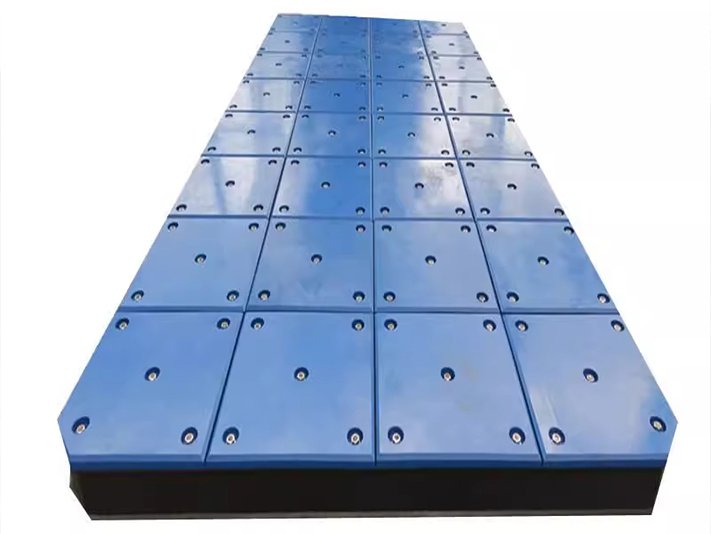
3. Marine Dock Fenders & Bumpers
Dock fender facing pads protect both the vessel hull and quay structure on impact. UHMW-PE absorbs 100% of impact energy elastically and shrugs off salt water indefinitely — it does not corrode, swell, or rot.
4. Outrigger / Crane Stabiliser Pads
Mobile cranes, concrete pumps, and bucket trucks distribute load to the ground via stabiliser pads. UHMW-PE pads are 1/8 the weight of steel pads, will not rust, and won't crack like polypropylene or recycled polymer. Standard sizes range from 300×300 mm to 1,200×1,800 mm.
5. Excavator Track Pads & Amphibious Equipment
Bolt-on UHMW-PE track shoes let tracked excavators work on asphalt, golf courses, and water-treatment plant floors without damaging the surface — a market-leading replacement for rubber pads.
6. Synthetic Ice Rinks & Hockey Training Surfaces
Self-lubricating UHMW-PE panels simulate real ice for figure skating, hockey shooting practice, and shopping-mall winter attractions — with no refrigeration, water, or electricity. Modern panels achieve 90–95% of natural-ice glide coefficient.
7. Food & Pharmaceutical Equipment
Cutting boards, scrapers, conveyor wear strips, bottle-handling guides, and rotary star wheels in dairy, beverage, meat-processing, and pharmaceutical lines. Virgin UHMW-PE meets FDA, EU 10/2011, and 3-A Sanitary Standard.
8. Chemical & Wastewater Equipment
Tank linings, splash guards, scrubber packings, and filter plates in chlor-alkali, electroplating, and wastewater treatment. UHMW-PE resists 95% of common acids, bases, and solvents at room temperature — only oxidising acids (concentrated nitric, fuming sulfuric) attack it.
9. Ground & Turf Protection Mats
Heavy-duty HDPE/UHMWPE composite ground mats support up to 100 tons of equipment over soft soil, sand, or grass — protecting both the equipment and the underlying surface during construction, events, and oilfield operations.
10. CNC-Machined Custom Parts
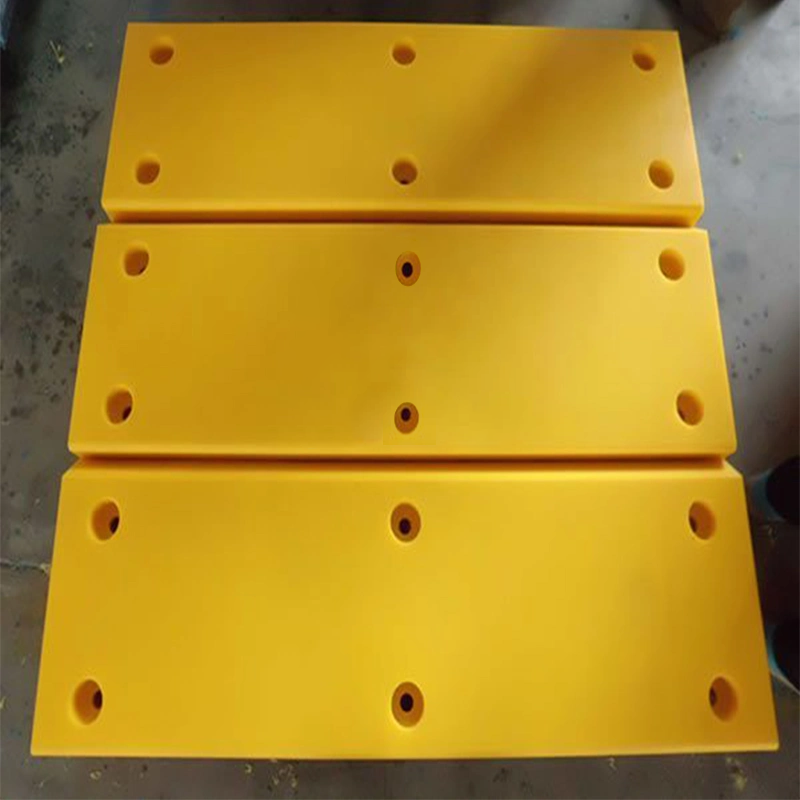
Sprockets, sliders, bushings, gears, rollers, sleeves, scraper blades, and any custom part where wear, impact, or food-grade compliance is critical. We CNC-machine over 200 part numbers per month from customer drawings.
5. Why Engineers Choose UHMW-PE — 6 Big Benefits
- Self-lubricating. No grease or oil needed — eliminates lubrication maintenance and prevents product contamination in food/pharma applications.
- Quiet running. Damps vibration; conveyor noise drops 10–20 dB after a steel-to-UHMW-PE liner swap.
- Lightweight. 1/8 the density of steel — easier installation, no lifting equipment needed for typical sheet sizes.
- Corrosion-proof. Will not rust, rot, or attract barnacles. A natural fit for marine, wastewater, and food applications.
- Cold-temperature toughness. Stays ductile down to −200°C, the only mainstream plastic that does.
- Long service life. Typical replacement intervals are 5–10 years longer than competing materials — payback period is usually under 12 months.
6. Limitations — When NOT to Use UHMW-PE
UHMW-PE isn't magic. Here are four scenarios where you should consider alternatives:
- Service above 80°C continuous. The polymer softens. Use HDPE-HMW (still ~80°C), polypropylene (100°C), or for high-temp wear, Nylon PA66 with MoS2 fill.
- High mechanical load with tight dimensional tolerance. UHMW-PE creeps under sustained load. For precision gears, bushings under high pressure, switch to POM (Acetal) or PEEK.
- Bonding requirements. UHMW-PE is essentially impossible to glue without surface flame or plasma treatment. Mechanical fastening (bolts, dovetails, clamps) is preferred.
- UV-exposed colours. Natural-white UHMW-PE chalks under intense UV after 5–7 years; specify black UV-stabilised grade (carbon-black filled) for outdoor use.
7. How to Specify & Source UHMW-PE
Whether you are buying 10 sheets or a full container, get the following information from your supplier in writing:
- Molecular weight (e.g. PE1000 = 9.2 million; PE500 = 0.5 million – that's HDPE, not UHMW-PE).
- Process route (compression-moulded vs ram-extruded). Moulded sheet has lower internal stress and is preferred for large flat liners; extruded is fine for wear strips.
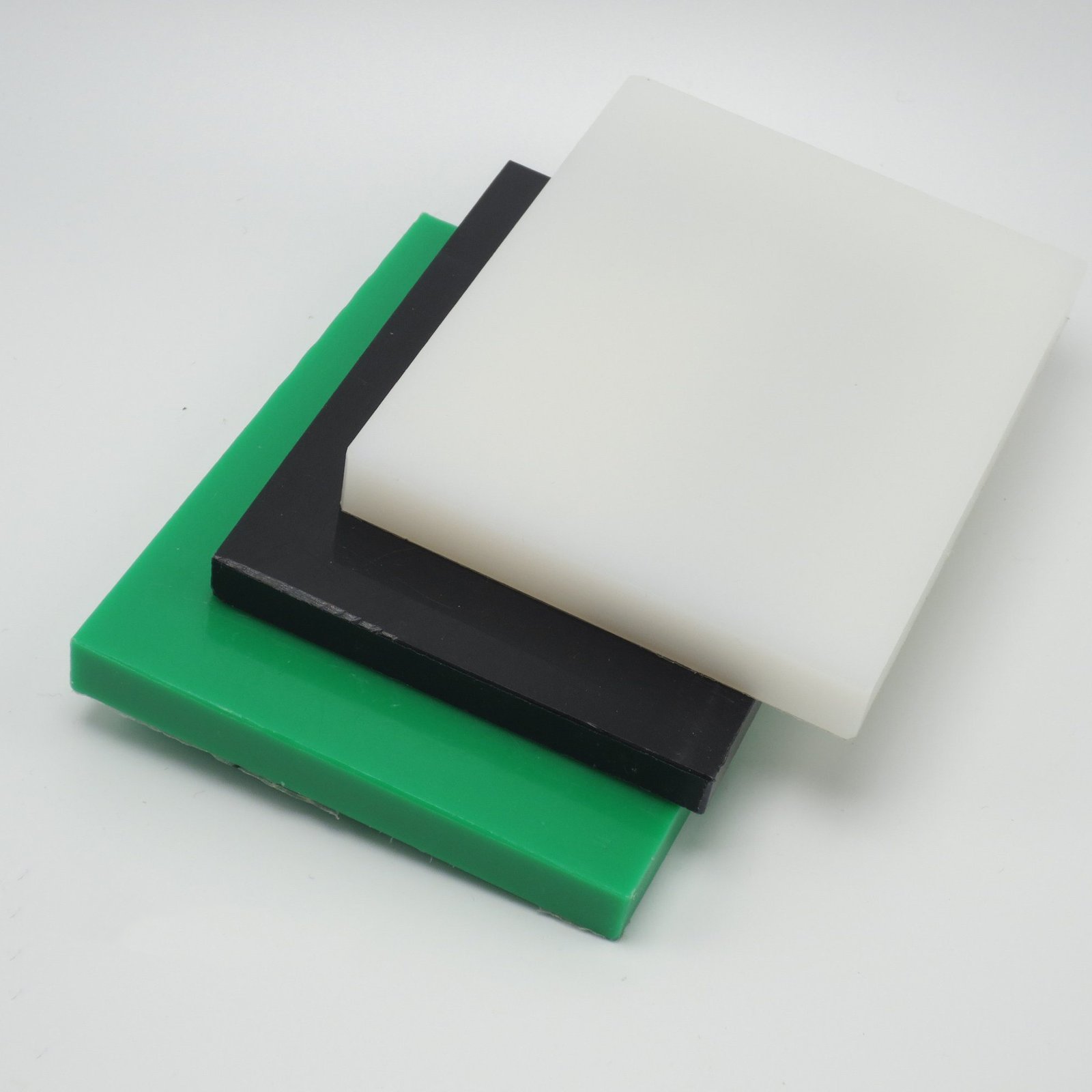
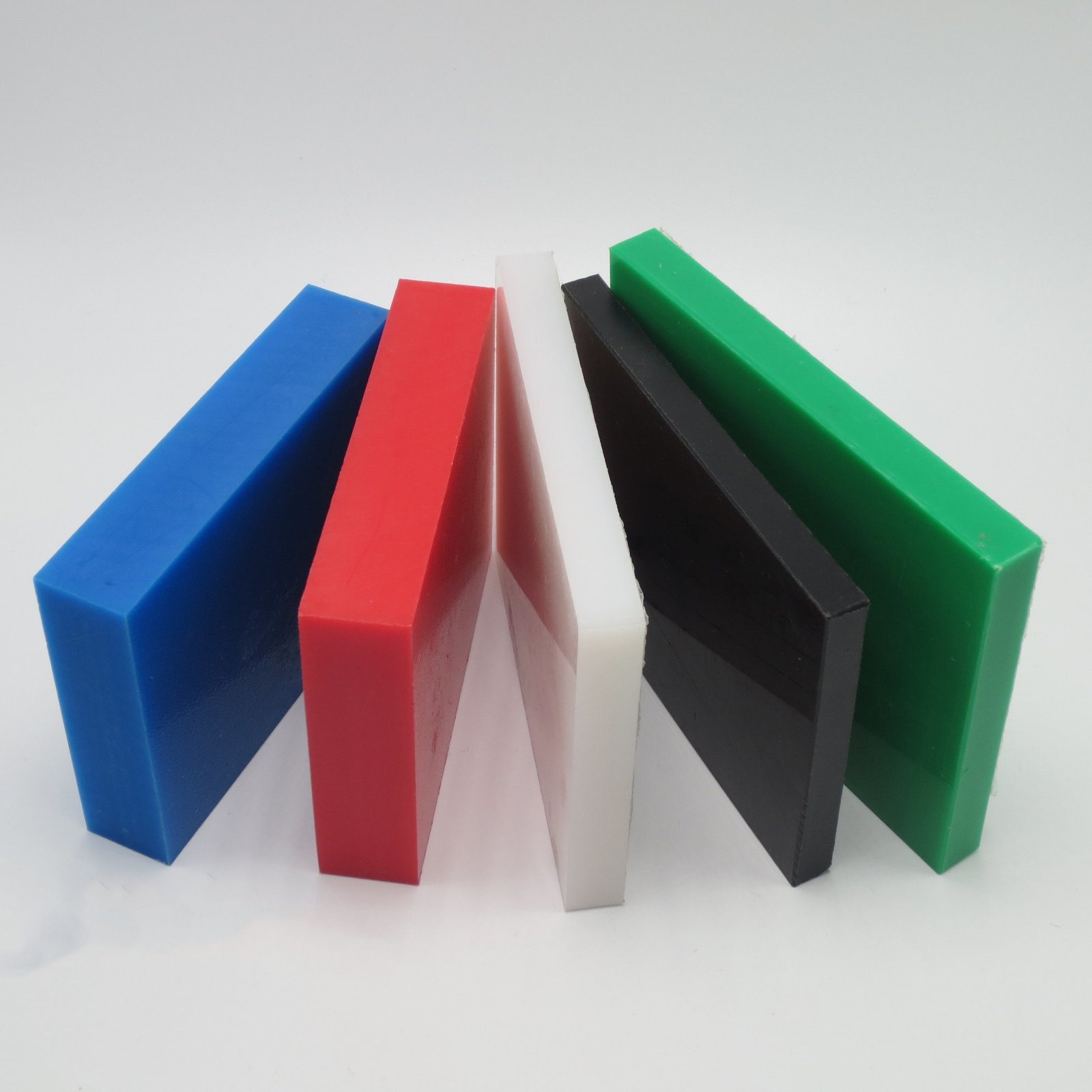
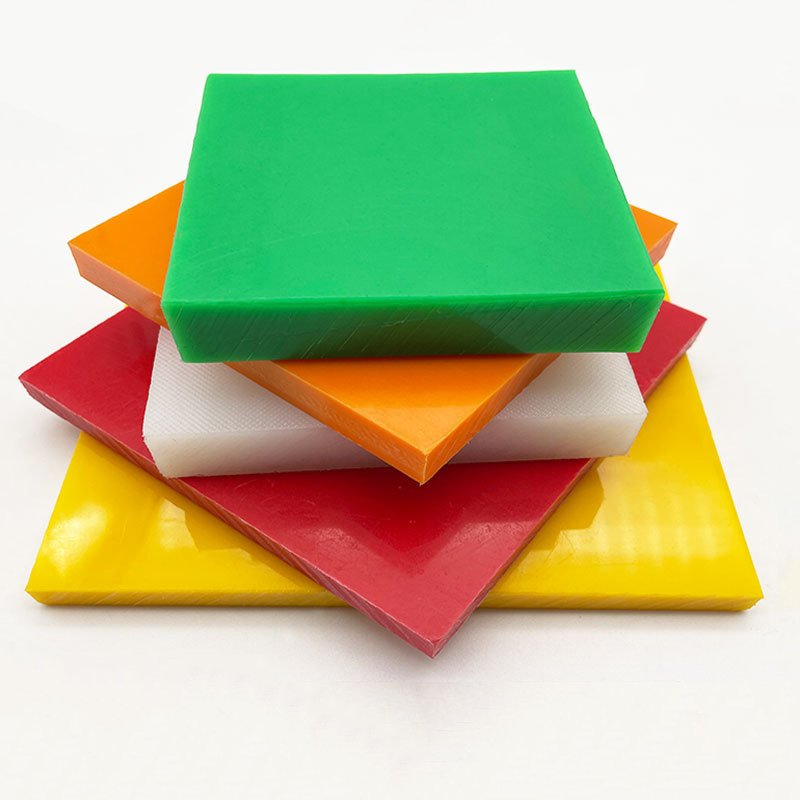
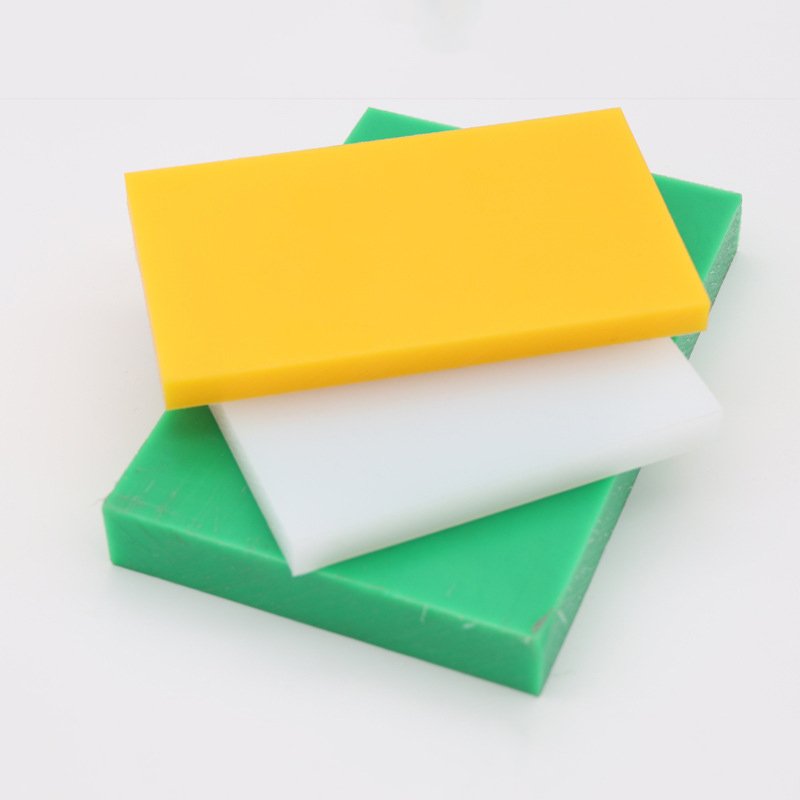
- Fill / colour code — natural (white-translucent), black UV, green/red food-grade, antistatic (carbon nanotube filled), boronated (neutron shielding), oil-filled, glass-bead reinforced.
- Compliance certificates — FDA, EU 10/2011, 3-A Sanitary, REACH, RoHS, CE, SGS / FDA / RoHS verified — whichever applies to your industry.
- Sheet size and tolerance. Standard sizes are 1,000×2,000 mm and 1,250×3,050 mm; thickness 3–200 mm with ±10% on standard, ±0.2 mm on calibrated grade.
If you are sourcing from China, look for an SGS / FDA / RoHS verified-certified factory with at least 5 years of UHMW-PE-specific production, in-house CNC capability, and the ability to issue Trade Assurance / Letter of Credit on real export volume. Jiasheng Plastics ticks all four boxes — we have shipped to 40+ countries since 2013, hold SGS / FDA / RoHS verified, FDA, and SGS certificates, and operate a 5,000+ m² factory in Dezhou, Shandong.
8. Frequently Asked Questions
Is UHMW-PE the same as PE1000?
Yes. PE1000 is a common European trade designation for UHMW-PE with a molecular weight around 9–10 million g/mol. PE500 refers to HDPE, PE300 to MDPE.
What is the maximum service temperature?
Standard UHMW-PE: continuous −200°C to +80°C, short-term to +100°C. Crosslinked grades reach +120°C.
Is UHMW-PE FDA / food grade?
Virgin natural-color UHMW-PE complies with FDA 21 CFR 177.1520, EU 10/2011, and 3-A Sanitary Standard 20-27. Always request a Declaration of Compliance from your supplier.
How does UHMW-PE compare to HDPE in wear resistance?
UHMW-PE is approximately 6–10 times more abrasion-resistant than HDPE in standard sand-slurry tests, due to its much longer polymer chains.
Can UHMW-PE be machined like metal?
Yes. Use sharp tools, generous coolant or air, and high feed rates. Tolerances of ±0.05 mm are achievable on small parts.
What is the typical lifespan of a UHMW-PE wear part?
In a typical bulk-handling conveyor: 8–15 years before replacement — 5–10× longer than steel or HDPE alternatives.